Presenter
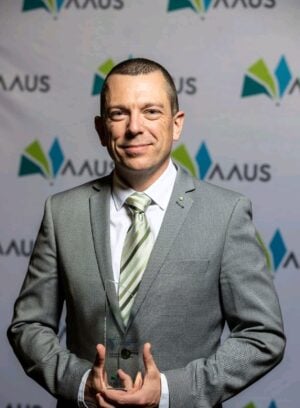
WGCDR Keirin Joyce
Deputy Director Disruptive Experimentation,
Jericho Disruptive Innovation
Wing Commander (WGCDR) Keirin Joyce is an Australian Defence Force Academy graduate with an Honours Bachelor of Aeronautical Engineering. WGCDR Joyce has spent the last 20 years in support of the ADF Uncrewed Aerial Systems (UAS) capability including deployment to Iraq and Afghanistan.
WGCDR Joyce is currently responsible for Disruptive Innovation in Air Force HQ. He was the 2014 Chief of Army Scholar, the 2025 Sir Richard Williams Fellow and has twice been awarded the Spitfire Memorial Defence Fellowship in 2009 and 2024. For his efforts on the acquisition of the RQ-7B Shadow 200 Tactical UAS he was awarded a Conspicuous Service Cross in the 2012 Honours List.
Keirin is married to Rachael, an expert democracy, electoral and government educator, they have four children, including their son Declan who is serving as an Aircraft Technician in the Royal Australian Navy. He is the President of the ADF Drone Racing Association.
WGCDR Keirin Joyce from Jericho Disruptive Innovation, will present a seminar on Thursday, 11 June 2026.
Title: Autonomy Deficits: Barriers to Fielding Large UAS.
Abstract: Uncrewed Aerial Systems (UAS) have long been explored for larger roles. While a number of systems offering small-payloads in commercial drone delivery and in military contexts have seen operational use, large and fast UAS have yet to be adopted. A range of setbacks causes this, including technological and operational challenges that hinder the adoption of large and fast UAS. Here, we evaluate these challenges from a conceptual modelling perspective and forecast their applicability once these barriers are overcome. The study utilises technology trend modelling and activity mapping methodologies to predict the applicability of specific technologies that are currently identified to be operational challenges. Specifically, we model trends in technological improvements of the battery technology and aircraft control, and project its focus on landing zone and flight autonomy. These models are validated through case studies of small commercial delivery drones and then applied to assess the feasibility and constraints of larger UAS. Our analysis reveals that while small logistics UAS have been successfully integrated into operations, key technologies required for large-scale UAS have yet to build-up a critical mass of research activity, particularly on landing zone and flight autonomy. Moreover, additional constraints beyond technological and operational challenges could include limitations in autonomy, certification hurdles, regulatory complexity, and the need for social and customer trust and acceptance.
Click the button below to register, add an invitation to your calendar and join the seminar using the Teams/GovTeams link.